
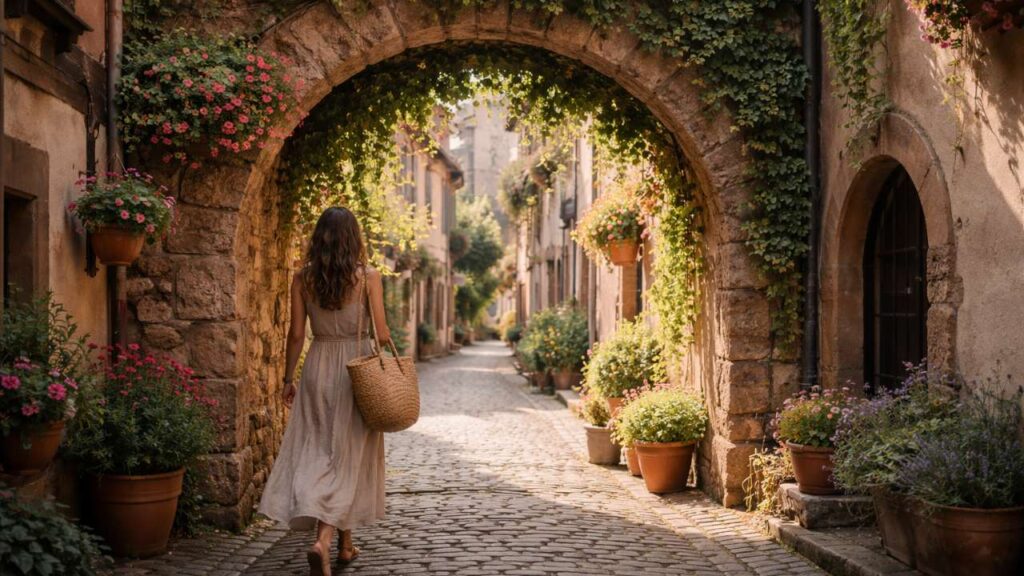
The first time you walk a street, you’re oriented outward.
You’re scanning—where it leads, what it offers, how it fits into the day.
The second time, something shifts.
The street no longer asks for direction.
It invites attention.
This is the quiet magic of walking the same street twice—a small but powerful slow travel practice. Not because it’s efficient, but because repetition dissolves urgency, and presence rushes in to take its place.
The First Walk Is About Arrival
On the first pass, the mind is busy. You’re absorbing the obvious: the curve of the road, the colors of façades, the hum of life. You notice landmarks because they help you situate yourself.
Your body moves a little faster. Your eyes skim.
It’s not shallow—it’s necessary. The first walk teaches you where you are.
The Second Walk Is About Belonging
When you return, the street feels different. Familiar. Safer.
You slow without trying. Your gaze softens. You begin to notice what didn’t register before—not because it wasn’t there, but because you weren’t ready to see it.
The second walk isn’t about discovery.
It’s about recognition.
This is where slow travel begins to take shape—not as a philosophy, but as a felt experience.
You may also enjoy: Roussillon, France: One of the Most Charming French Towns

What Is Slow Travel, Really?
Slow travel isn’t about moving less.
It’s about being present enough to notice more.
At its core, slow travel means:
- returning instead of rushing onward
- depth instead of accumulation
- rhythm instead of schedules
Walking the same street twice is a perfect example of the slow travel mindset. Nothing new is added, yet everything changes. The place hasn’t shifted—you have.
Slow travel invites you to stay long enough for familiarity to form, even briefly. And familiarity is where meaning grows.
Details Begin to Surface
Repetition sharpens perception.
You notice:
- the way one shutter is always half-open
- a chair that never moves from its place by the door
- how the light hits the same stone differently by the hour
- a café table that’s rarely empty, but never loud
These details don’t announce themselves.
They wait for you to return.
This is why slow travel often feels richer than fast-paced itineraries—it creates space for subtleties to emerge.
You may also enjoy: Eguisheim, France: A Fairytale Among French Villages

The Street Reveals Its Rhythm
Every place has a pulse. You rarely hear it on the first walk.
On the second, patterns emerge:
- when deliveries arrive
- when streets empty
- when people pause instead of passing through
You begin to sense the difference between movement and routine. The street stops feeling like a route and starts feeling like a rhythm.
This rhythm is what slow travelers tune into instinctively.
You Notice Yourself Differently Too
Walking the same street twice doesn’t only change what you see—it changes how you move.
Your shoulders relax. Your pace adjusts. You stop checking your phone. You’re no longer navigating; you’re inhabiting.
This is when travel shifts from observation to experience—one of the quiet promises of slow travel.
Repetition Creates Memory
We often believe novelty creates memory.
In truth, repetition does.
The streets you remember most aren’t the ones you rushed through once. They’re the ones you returned to—by choice, not necessity.
Memory forms when something familiar becomes meaningful. When a place begins to feel known, even briefly.
You may also enjoy: 10 Most Beautiful Fairytale Villages in France to Add to Your Bucket List
Why Slow Travelers Re-Walk on Purpose
Slow travelers understand this intuitively. They don’t chase new streets every day. They return.
They walk the same route in the morning and again at dusk. They pass the same door without needing to look at it—and then notice something new anyway.
Re-walking isn’t stagnation.
It’s deepening.
You may also enjoy: 20 Travel Essentials Every Woman Should Pack

What Changes When You Stop Moving Forward
Modern travel rewards progress: new neighborhoods, new sights, constant movement. But meaning often lives just behind you.
When you choose to walk the same street again, you trade expansion for depth. You let a place unfold at its own pace rather than demanding it perform.
And in that stillness, the street offers more than scenery.
It offers intimacy.
A Quiet Slow Travel Practice You Can Try Anywhere
Wherever you are—village, city, unfamiliar town—choose one street and walk it twice.
Not back-to-back. Let time pass.
Notice what you didn’t see the first time. Notice how your body responds the second. Notice what feels unchanged and what feels newly visible.
This small act can turn a trip into something far richer than a checklist ever could.
A Gentle Takeaway
Walking the same street twice teaches you that slow travel doesn’t deepen by adding more—it deepens by returning.
When you stop chasing what’s next, what’s already around you begins to speak.
And sometimes, the most revealing journey is the one you’re willing to repeat.


