
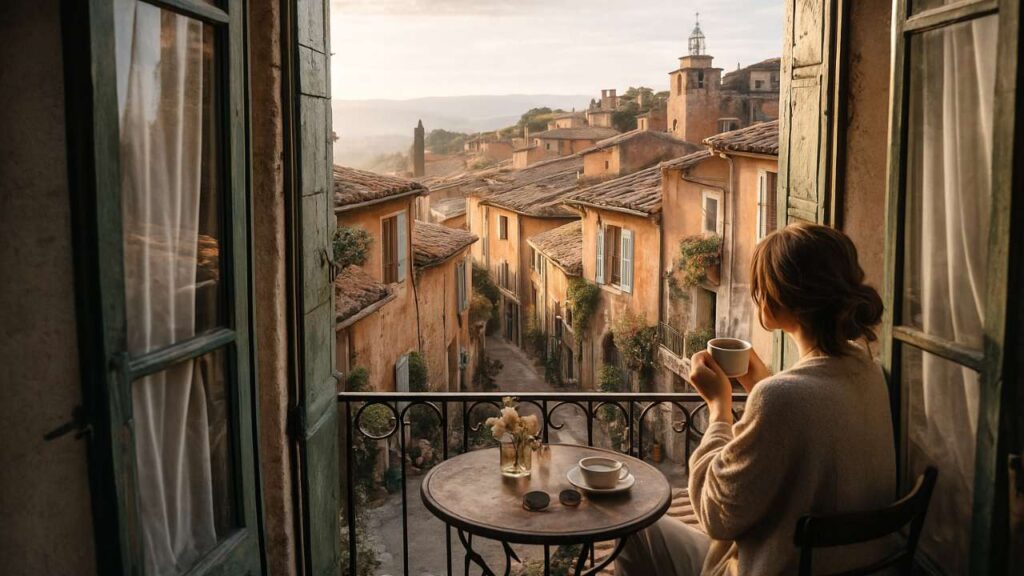
Some places announce their beauty immediately.
Roussillon does something quieter.
You arrive surrounded by color—ochre reds, warm oranges, soft yellows—and for a moment it feels almost unreal. Then, just as quickly, the color settles into the background. It becomes normal. And that is when Roussillon begins to reveal its true charm.
This is not a town that asks to be admired constantly.
It asks you to stay.

The First Few Minutes Feel Like a Painting
Roussillon doesn’t “ease you in.” It immerses you.
Even before you reach the heart of the village, the landscape begins to shift—more honeyed, more mineral, more sun-warmed. The air feels dry in that distinctly Provençal way, scented with pine and herbs when the breeze lifts. And then the town appears: stacked houses in layered pigments, like the hillside itself decided to become architecture.
It’s stunning, yes. But the real magic is what happens next.
Once your eyes stop exclaiming over every wall, you start noticing the softer things: the way footsteps sound on stone, the quiet choreography of shutters opening, the gentle pause people take in doorways as if time is optional here.
Living Inside Color
Roussillon is shaped by the land it stands on. The ochre that made the village famous was once drawn from the surrounding earth and used to color its homes. Over time, those pigments became part of everyday life—not decoration, but material.
Houses wear different shades of ochre naturally. Some lean red, others golden, others pale and sun-softened. Shutters fade gently into blues and greens. No two façades are the same, yet nothing feels out of place.
The village doesn’t feel designed.
It feels grown.
And that’s the difference between a pretty place and a true one: Roussillon doesn’t look curated for visitors. It looks like it was built for living—then quietly discovered.
Where the Charm Really Lives: In the In-Between Moments
Roussillon is not a place to rush through with a checklist. Its charm lives in small, unremarkable moments:
- Walking past a doorway framed by terracotta pots.
- Watching light change across a stone wall.
- Passing someone heading home, unhurried.
- Hearing a soft “bonjour” that feels like a ritual rather than a greeting.
There is no need to constantly stop. In fact, the town feels most itself when you don’t.
The streets are narrow, the rhythm unforced. Life moves at a pace that seems to adjust you, rather than the other way around. You start walking more slowly without trying. You look up more often. You notice shadow and texture and tiny contrasts—olive-green against saffron, faded blue against brick-red.
The Ochre Trails Are Beautiful—But Don’t Make Them the Whole Story
Many visitors come for the ochre paths just outside the village, and they are undeniably beautiful: carved earth, glowing cliffs, and winding routes that make you feel like you’ve stepped onto another planet—only softer, warmer, more elegant.
But the heart of Roussillon lies just beyond them.
It’s in the village lanes where color becomes background, not spectacle. Where ochre walls frame daily routines rather than scenic viewpoints. Where the town reveals itself not as a destination, but as a place people live.
Roussillon doesn’t compete for attention.
It simply continues.
A Village Made for Wandering
One of the loveliest ways to experience Roussillon is to let yourself get slightly lost—intentionally.
Choose a lane that looks too narrow to lead anywhere. Follow the curve. Let the town rearrange itself around you. You’ll find:
- Small staircases that feel like secret passages
- Corners where the light pools in the warmest tones
- Little openings where the view suddenly stretches out over the Luberon landscape
- Quiet pockets where you can hear your own pace again
It’s not a town that rewards speed. It rewards presence.
Architecture That Belongs to Its Place
The charm of Roussillon is deeply architectural, but not in a monumental way. Thick walls keep interiors cool. Small windows manage the light. Shutters, doors, and stone steps reflect centuries of practical adaptation.
Nothing here feels performative. The village wasn’t built to impress—it was built to endure. And that quiet honesty is what makes it so compelling.
Even the imperfections are beautiful: chipped corners, worn steps, sun-softened paint. It all feels like proof of real life.
You may also enjoy: 10 Most Beautiful Fairytale Villages in France to Add to Your Bucket List

The Best Light in Roussillon
If you’re the kind of traveler who notices atmosphere (and if you’re here, you probably are), timing matters.
- Morning feels calm and clean—perfect for wandering while the streets are still sleepy.
- Late afternoon turns everything golden-hued and cinematic, when the walls glow as if lit from within.
- Early evening is pure softness—lantern light, gentle shadows, and the sense that the village is exhaling.
If you’re photographing, you’ll find that Roussillon isn’t about sharp contrast. It’s about warmth. The tones blend, harmonize, and soften edges—like nature’s own filter.
What to Do in Roussillon (Without Turning It Into a Checklist)
Think of this as a menu, not a mission.
1) Wander the historic lanes
Let the village lead. The most charming corners are rarely the ones you planned.
2) Walk the ochre paths
Pick the shorter route if you want something breezy and dreamy; choose the longer route if you want more immersion and views. Either way, wear shoes you don’t mind getting dusty—ochre loves to follow you home.
3) Pause at viewpoints
Roussillon has those quiet panoramic moments where rooftops give way to countryside. Stay a little longer than you normally would. Let the view become a feeling, not a photo.
4) Sit down—properly
Not a rushed coffee. Not a quick sip. Choose a terrace, order something simple, and allow the village to pass by like a slow film.
5) Notice the details
This is the true Roussillon ritual: textures, shutters, terracotta, stone, shadows. The beauty is everywhere, but it whispers.
Also Read: Colmar, France: The Fairytale Town You Need to Visit

A Chic Little Guide: What to Wear + What to Pack
Roussillon is warm, walkable, and wonderfully tactile—so dress for ease, but keep it elevated.
What to wear (effortless Provence energy):
- Linen shirt or a cotton poplin dress
- Comfortable sandals or light sneakers (the lanes can be uneven)
- A straw hat or scarf for sun
- A light layer for evenings, especially outside peak summer
What to pack:
- Water (especially if you’re walking the trails)
- Sunglasses—this kind of sunlight is bright and honest
- A small crossbody bag (hands free for wandering)
- Wet wipes or a small cloth (ochre dust is part of the experience)
How Long to Stay: The Secret to Falling in Love
Roussillon can be “done” in a few hours—technically.
But that’s like tasting perfume from the cap and calling it a full wear.
To truly feel it:
- Half day gives you the lanes + trails, but it can feel quick.
- Full day lets you slow down, linger, and experience the light changing.
- Overnight is the dream: early morning quiet, evening glow, and that rare feeling of having a beautiful village all to yourself.
If you can, stay the night. Roussillon becomes even more itself when day-trippers leave and the town returns to its natural rhythm.
Small Things That Make Your Visit Better
A few gentle tips—nothing fussy, just helpful:
- Go early or late if you prefer calm streets and softer light.
- Wear practical shoes—those charming lanes are charmingly uneven.
- Respect the quiet—it’s part of the beauty here.
- Don’t overplan—Roussillon rewards spaciousness.
Why Roussillon Stays With You
Long after you leave, Roussillon lingers in subtle ways. Not as a list of highlights, but as a feeling.
You remember the color not as something dramatic, but as something lived with.
You remember the pace more than the sights.
You remember how easy it felt to slow down.
That is the charm of Roussillon.
It doesn’t demand memory—
it earns it.
You may also enjoy: Eguisheim, France: A Fairytale Among French Villages

10 Common Mistakes to Avoid in Roussillon (France)
- Arriving at midday and expecting “quiet Provence.”
The light is harsh, the lanes feel busier, and the town can seem more crowded than it truly is. - Treating the village like a quick photo stop.
Roussillon’s charm is slow—give it time to shift from “wow” to “I could stay here.” - Wearing slippery soles or impractical shoes.
Stone steps, uneven lanes, and ochre dust don’t love delicate sandals. - Skipping the “no-plan wander.”
If you only follow the main route, you miss the tucked-away corners where the village feels most real. - Forgetting water and sun protection.
Provence sun is bright and persistent, especially if you’re walking the ochre paths. - Underestimating ochre dust.
It gets on shoes, hems, and hands—avoid wearing your most precious whites if you’ll do the trails. - Only seeing the Ochre Trail and leaving immediately.
The trails are beautiful, but the village lanes are where the atmosphere lives. - Expecting lots of “major monuments.”
Roussillon is more about texture, light, and lived-in beauty than big-ticket sights. - Dining at peak hours without a plan.
You may end up with long waits (or rushed choices). A slightly earlier lunch feels more relaxed. - Being too loud in the quiet lanes.
Roussillon’s magic is gentle—keep your voice soft and let the village set the tone.
A Place Worth Lingering In
Among France’s many beautiful towns, Roussillon stands out not because it tries to, but because it doesn’t. Its charm lies in restraint, rhythm, and everyday life shaped by the land beneath it.
If you’re drawn to places that feel quietly complete—places where beauty becomes part of the background—Roussillon is one of the most charming French towns you can experience.
Not to see.
But to stay with.
Video Featuring Scenic Roussillon, France
10 FAQs About Visiting Roussillon, France
- Is Roussillon worth visiting?
Yes—especially if you love color, hillside villages, and slow, atmospheric wandering. - How much time do I need in Roussillon?
A half day works, a full day feels ideal, and overnight is the most serene (morning and evening light are gorgeous). - What is Roussillon famous for?
Its ochre-colored buildings and the ochre landscapes just outside the village. - Do I need a car to visit?
A car is the easiest way to explore the Luberon area and arrive on your own schedule, but you can visit via regional transport + taxis (it’s simply less flexible). - What should I wear to Roussillon?
Breathable pieces (linen, cotton), comfortable walking shoes, sunglasses, and a light layer for evening. - Is the Ochre Trail hard?
It’s generally manageable, but it can be dusty and warm—good shoes and water make it much more pleasant. - What’s the best time of day to visit?
Early morning for calm streets, late afternoon for the softest, most golden-hued light. - Is Roussillon good for families?
Yes—kids often love the colors and the ochre paths. Just keep an eye on little ones near uneven steps and dusty sections. - Will my clothes get stained by ochre?
Usually it’s more like dust than permanent stain, but it can cling—avoid fragile fabrics and be mindful with light colors. - Can I visit Roussillon year-round?
The village is lovely in every season, but the experience changes: summer is bright and lively, while shoulder seasons feel calmer and more “slow Provence.”


