
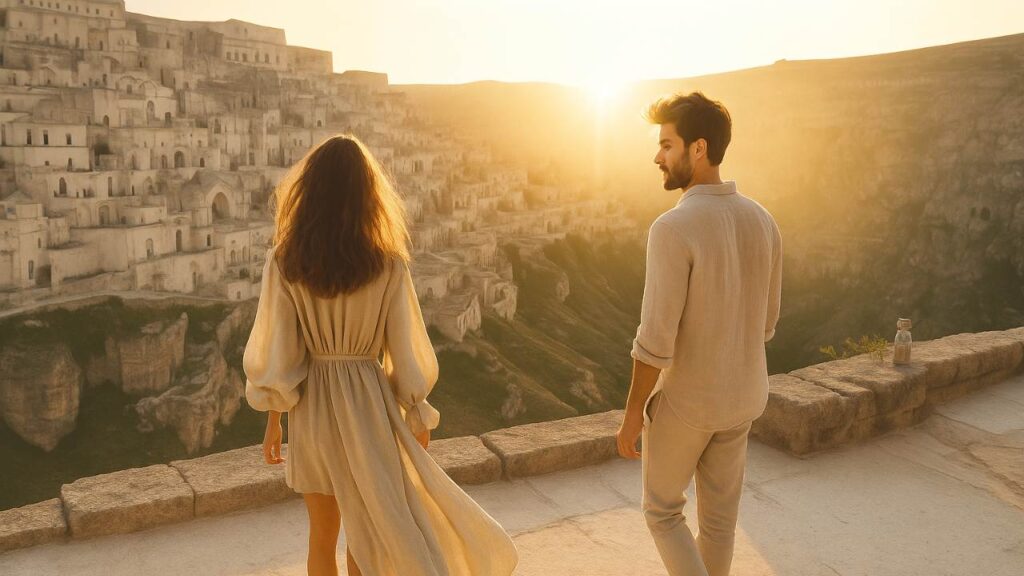
There’s nowhere on Earth quite like Matera — a city that looks as if it was sculpted by time itself. Perched in the rugged region of Basilicata, just across the border from Puglia, Matera is often called “the city of stone”. Its ancient cave dwellings, known as the Sassi, form a labyrinth of stairways, arches, and carved homes that cascade down a canyon overlooking the Gravina River.
Once forgotten, Matera has become one of Italy’s most extraordinary success stories — transforming from poverty and neglect into a UNESCO World Heritage Site and one of Europe’s most captivating destinations.
A City Older Than History
Matera is among the oldest continuously inhabited cities in the world, with evidence of settlement dating back over 9,000 years. The Sassi di Matera — literally “stones of Matera” — are two districts, Sasso Caveoso and Sasso Barisano, carved directly into limestone cliffs.
For centuries, people lived here in cave homes without electricity or plumbing, often sharing space with livestock. In the 1950s, the Italian government evacuated the Sassi, calling it a “national shame.” But decades later, artists, architects, and dreamers returned — restoring the caves into boutique hotels, cafés, and galleries. Today, what was once abandoned now hums with quiet sophistication.
Exploring the Sassi Districts
Start your journey at Piazza Vittorio Veneto, the city’s main square, which overlooks a breathtaking panorama of the Sassi below. From here, wander into Sasso Barisano, where ancient caves blend with more recent stone buildings, and artisan shops line the narrow lanes.
Cross over to Sasso Caveoso, the older and more dramatic side, where homes seem to melt into the rock. Don’t miss the Casa Grotta di Vico Solitario, a preserved cave dwelling showing what life here looked like before modern times.
Above it all sits Civita, the highest part of Matera, crowned by the Cathedral of Madonna della Bruna, its Romanesque façade gleaming against the pale stone landscape.
Matera’s Cinematic Magic
If the scenery feels familiar, it’s because Matera has long been a favorite of filmmakers. Its hauntingly ancient look has stood in for Jerusalem in “The Passion of the Christ”, “Ben Hur”, and even a recent James Bond film, No Time to Die.
At sunset, when the entire city glows honey-gold and the Sassi light up like lanterns, Matera feels less like a film set and more like a dream suspended in time.
Things to Do in Matera
- Explore the Cave Churches: Visit the Crypt of the Original Sin (Cripta del Peccato Originale), known as the “Sistine Chapel of Rupestrian Art.” Its 8th-century frescoes are astonishing.
- Walk Across the Gravina Canyon: The Ponte Tibetano della Gravina (Tibetan bridge) connects the Sassi to the park of Murgia Materana, offering breathtaking views.
- Stay in a Cave Hotel: Experience the unique charm of sleeping inside a restored cave at one of Matera’s boutique hotels — a mix of ancient atmosphere and modern luxury.
- Visit MUSMA: The Museum of Contemporary Sculpture in Matera, housed in a network of caves, is a fascinating blend of modern art and ancient stone.
- Enjoy Matera by Night: The view of the illuminated Sassi from Belvedere di Murgia Timone is unforgettable — a sea of golden lights cascading down the cliffs.
Where to Eat in Matera
Matera’s cuisine is rooted in simplicity — local grains, olive oil, and strong flavors born from peasant traditions.
Try pane di Matera, the famous local bread made from durum wheat and natural yeast — it’s recognized by a European Protected Designation of Origin (PDO). Pair it with caciocavallo cheese, local wines from Basilicata, and traditional dishes like orecchiette with cruschi peppers.
For dinner with a view, book a table at a cave restaurant overlooking the Sassi — dining here feels like stepping back in time, candlelight flickering against ancient walls.
You may also enjoy: Amalfi Coast Italy: 7 Secrets for a Perfect Holiday

When to Visit Matera
The best time to visit is April to June or September to October, when the weather is mild and the crowds are fewer. Summer can be hot, and winter brings a quieter, almost spiritual side to the city.
Matera is accessible from Bari, Brindisi, or Naples, with regular buses and trains connecting the city. Most travelers combine it with a Puglia road trip — the drive between Alberobello and Matera takes just over an hour.
10 Common Mistakes to Avoid in Matera
1. Trying to see everything in one day
There’s too much history and detail to rush. Stay at least one night to appreciate its rhythm and night views.
2. Wearing the wrong shoes
Heels and thin soles don’t work on the uneven stone paths. Bring good walking shoes with grip.
3. Exploring only one side of the Sassi
Both districts have a different feel — one more dramatic, the other more lived-in. Spend time wandering through each.
4. Skipping sunset or night views
When the lights come on, the old town glows like a sea of lanterns. It’s one of the most beautiful scenes in Italy.
5. Missing the local food
Try Matera’s signature bread, locally made cheeses, and simple pasta dishes. The cuisine here is earthy and deeply satisfying.
6. Visiting in the peak midday heat
Temperatures can rise quickly in summer. Plan walks early in the morning or later in the evening.
7. Expecting to drive into the old town
Most of the Sassi is pedestrian-only. Park nearby and explore on foot — that’s part of the experience.
8. Not taking a local tour
Guides share stories you’d never find on your own — about the people who once lived in the caves and how the city came back to life.
9. Forgetting to bring water and sunscreen
The stone reflects heat, and there’s little shade. Stay hydrated while exploring.
10. Leaving before exploring the Murgia plateau
Across the canyon are ancient cave churches and panoramic views of Matera — a short hike that’s completely worth it.
You may also enjoy: Puglia Italy Travel Guide: Whitewashed Towns, Olive Groves & Adriatic Dreams

Why Matera Should Be on Your Italy Itinerary
Matera isn’t just a destination — it’s a story of rebirth.
A place that was once left behind and has now become a living museum of resilience, creativity, and human endurance. Walking through its silent lanes, you don’t just see history — you feel it, carved in every stone.
10 FAQs About Visiting Matera
1. Where is Matera located?
Matera lies in the southern Italian region of Basilicata, close to the border with Puglia. It’s around an hour’s drive from Alberobello or 75 minutes from Bari.
2. Why is this city so famous?
It’s known for its ancient cave dwellings, called the Sassi, which are carved directly into the limestone cliffs. The entire area has been recognized as a UNESCO World Heritage Site for its historical and cultural value.
3. Is it worth visiting?
Definitely. Few places in Italy feel as unique and atmospheric. Walking through its stone lanes feels like stepping back in time — there’s nothing quite like it anywhere else in Europe.
4. How many days do I need?
Spend at least two days if you can. A day trip lets you see the highlights, but an overnight stay reveals Matera’s real magic — especially at night, when the city lights up in golden tones.
5. When is the best time to go?
Spring and autumn are ideal. The months from April to June and September to October bring mild weather and fewer crowds.
6. How can I get there?
The nearest major city is Bari, which has both an airport and train connections. You can drive, take a bus, or use the local train line that runs from Bari to Matera.
7. Can you stay inside the caves?
Yes, and it’s a highlight of visiting. Many of the old cave homes have been turned into beautiful boutique hotels that mix ancient atmosphere with modern comfort.
8. What should I wear?
Comfortable shoes are essential. The streets are uneven and often steep. Light clothing works best in summer, but carry a jacket in the cooler months.
9. What should I see first?
Explore both Sassi districts — Caveoso and Barisano — along with the Cathedral, Casa Grotta Museum, and the scenic viewpoint at Murgia Timone across the canyon.
10. Is it expensive to visit?
Matera is more affordable than major Italian cities. You can enjoy great food, culture, and views without overspending, especially if you visit outside peak summer months.
You may also enjoy: 20 Things to Do in Portugal: From Lisbon to the Algarve


